

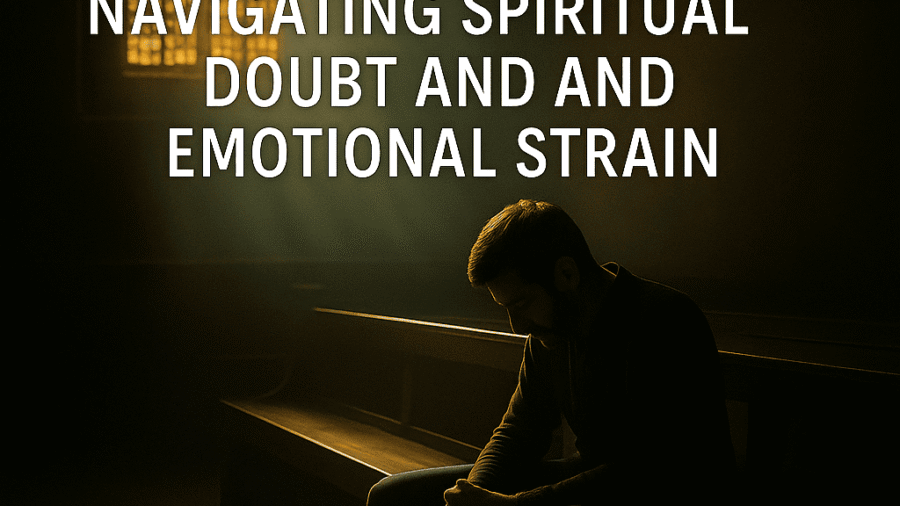
For many of us, religion and spirituality are not just set of belief systems we hold on to; they are emotional lifelines and identity constructs. They give us meaning, hope and a moral direction.
But what happens when our faith which was once a source of comfort, becomes shaky? In moments when the light of faith that once gave us hope begins to die out? When the words you used to speak to your divine being feel empty, sacred rites no longer gives you comfort then you wonder if anyone is listening at all to the silence prayers of your heart.
In this same moment, the very structure that once supported you now feels like a weight you cannot carry. What then do you do? Do you give up that part of that once gave you meaning?
This is the time to now understand, sit with and gently move through fragile faith while tending to your mental well-being. Because in the silence of prayer, doubt sometimes answers.
Why Spiritual Doubt Hurts So Deeply
According to Vieten et al., (2023), spiritual struggles can trigger or worsen symptoms of anxiety, depression and trauma, particularly if those doubts are met with shame or silence. Many individuals feel isolated in their doubt, fearing they are “losing their faith” or disappointing a higher power.
Because for most of us, faith is our believe, identity and direction. It shapes how we see ourselves, others, and the entire world as a whole. So, when cracks begin to appear in that foundation, it becomes a theological confusion mixed up with emotional disorientation.
But is this doubt a sign of spiritual weakness or a doorway to deeper understanding?
Emotional Triggers of Faith Fracture
Spiritual fragility is sparked or intensified by the most difficult times of life. Some common emotional triggers include:
- Loss of a loved one (leading to questions about fairness or divine will).
- Mental health crises like depression or panic disorders
- Unanswered prayers or continued silence from your object of worship
- Religious trauma from spiritual abuse, guilt, or rejection
- Conflict between identity and doctrine (e.g., sexuality, gender, mental illness)
According to Abrams (2023) on American Psychological Association, these moments are critical for healing. They are not times to push faith away or clinging blindly, but times of opening up oneself for spiritual and emotional honesty.
How Doubt and Mental Health Interact
When spiritual confidence crumbles, mental well-being can to. That is because faith usually provides structure, meaning and emotional regulation. Without it, individuals are likely to feel:
- Spiritually lost or abandoned
- Emotionally unanchored or hopeless
- Ashamed for doubting or questioning
- Scared of the anger of their divine entity or divine punishment
Sawab et al., (2024) in a systematic review found that spiritual connection increases resilience and also found that spiritual conflict can amplify emotional pain. So, when these pains are left unspoken, doubt can grow heavy.
It is because of this that a confession of your doubt is not risky, it is needed.
For some, fragile faith is not about doubt alone. It is rooted in spiritual trauma, deep emotional wounds from toxic theology, judgmental communities or manipulative religious leaders.
How to Heal When Faith Feels Fragile
If your faith feels shaken, there are ways to hold space for healing without forcing yourself into belief or abandoning your spiritual roots.
Here are some gentle ways to begin:
1. Name Your Doubts Without Judgment
Write them out. Speak them in a trusted space. Doubt loses power when it is voiced in compassion.
2. Seek Spiritually Informed Therapy
You may find it helpful to work with a trained therapist who respects your religious beliefs.
3. Reclaim Gentle Rituals
You do not need to return to everything immediately. Start small: a candle, a psalm, a silence walk. Let your practices be soft and sincere.
4. Find Safe Spiritual Communities
If your current faith community makes you feel guilty for questioning, then it may not be safe for you. Find communities where doubt is rooted in devotion.
5. Practice Mindfulness as Spiritual Grounding
Without belief, breath and stillness can ground you in the present moment. For guidance, try Top 5 Meditation Apps for Beginners in 2025 to explore mindfulness as a spiritual tool without theological tension.
Faith Evolves and So Do You

If you are in a point where the prayers no longer flow, the sermons are hollow or where the silence feels more deafening than the divine, then you need to know that: It is not brokenness, You are becoming.
Spiritual doubt is not the lack of faith. It is the invitation to a deeper, more honest one. Your questions are sacred. Your ache is seen. And your healing is possible.
You do not have to rush to fix it. You are allowed to rest where you are and let grace find you there.
And not to forget, religion and mental health are closely related.
REFERENCES
Abrams, Z. (2023, November). Can religion and spirituality have a place in therapy? Experts say yes. Monitor on Psychology, 54(8). Retrieved August 7, 2025, from https://www.apa.org/monitor/2023/11/incorporating-religion-spirituality-therapy
Abrams, Z. (2023, November 1). Can religion and spirituality have a place in therapy? Experts say yes. Monitor on Psychology, 54(8). Retrieved August 7, 2025, from https://www.apa.org/monitor/2023/11/incorporating-religion-spirituality-therapy
PsycheShare. (2025, May 23). Top 5 meditation apps for beginners in 2025. PsycheShare. Retrieved August 7, 2025, from https://psycheshare.com/top-5-meditation-apps-for-beginners-in-2025/
Sawab, S., Yusuf, A., Fitryasari, R., & Arifin, H. (2024). Spirituality and Recovery From Severe Mental Disorders: A Systematic Review. Journal of Psychosocial Nursing and Mental Health Services, 62(8), 11-17.
Vieten, C., Oxhandler, H. K., Pearce, M., Fry, N., Tanega, C., & Pargament, K. (2023). Mental health professionals’ perspectives on the relevance of religion and spirituality to mental health care. BMC psychology, 11(1), 439.
Add a Comment