


Patience is sweet but its fruit is sweeter, As the saying goes. But what makes this saying true? This comes from our ability to delay gratification and wait for the greater reward that comes later.
This idea was famously demonstrated in the Marshmallow Test, which showed that those who could wait patiently in the face of temptation often achieved better outcomes in the long run.
Now, picture a moment when desire and patience collide. A moment where you really want something, but you know it’s better to wait. If you give in too soon, you might miss out on something greater. Yes, that feeling of being torn between what you want now and what you know is best later.
This struggle is at the center of willpower. A skill that shapes how we make decisions, pursue goals, and navigate challenges. It’s also one of the key lessons we learn from the famous Marshmallow Test.
What is the Marshmallow Test?
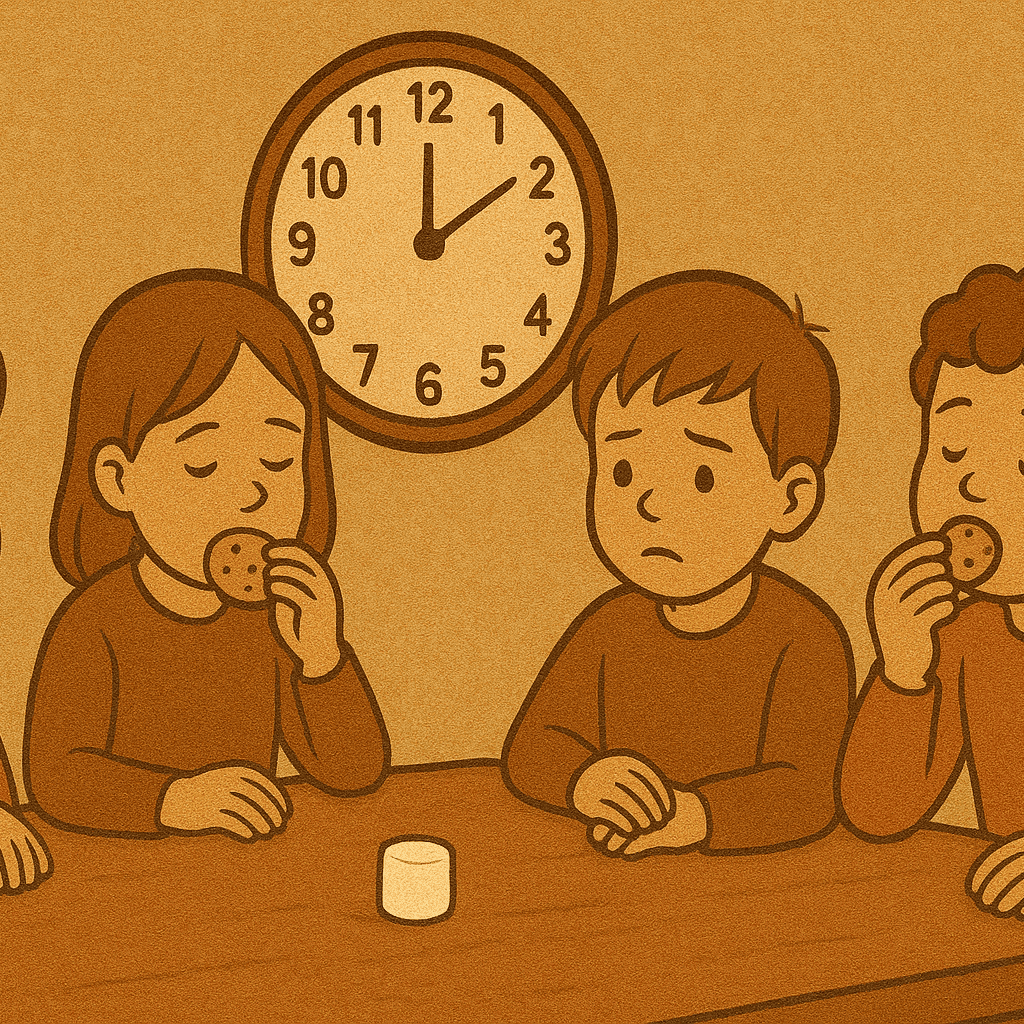
The Marshmallow Test began as a simple experiment to answer an interesting question, “why are some children able to wait for a reward while others aren’t?”
According to information on Wikipedia, Walter Mischel, a psychologist created a simple experiment with a group of children. He gave each child one marshmallow and told them that if they waited without eating it for about15 minutes, they would get a second one later. The goal of this experiment was to see how well they could delay gratification. That is their ability to resist a small reward now for a bigger one later.
In later years, the researcher found out that children who waited for the second marshmallow were performing better academically, had stronger social skills, and enjoyed better emotional health.
Recent studies, for example, a study by Watts et al. (2018) show that the Marshmallow Test is not just about natural willpower. The environment also plays a big part. Children who grow up in unpredictable or unstable environments often choose not to wait, not because they lack self-control, but because they have learnt to adapt to uncertainty. Their behaviour is because they can’t trust that rewards will come later.
So, children who grow up in unstable environments and experience broken promises or rewards taken away from them at any moment often choose not to wait for another marshmallow. Not out of poor discipline, but out of learnt survival: “Take what you can, when you can”.
We can then conclude that, both the original and revised conclusions agree that willpower and the ability to delay gratification are important predictors of behaviour and future outcomes. But people’s levels of self-control do make a difference. However, newer research adds more depth by showing that factors such as brain development, trust and environment also play important roles in shaping these behaviours.
Life Lessons from the Marshmallow Test
Although the Marshmallow Test began with children, its lessons are timeless and can apply to all ages. Every day, adults face their own marshmallows. These can be the temptation to check social media, procrastinate on work or indulge in unhealthy habits.
Understanding how to manage these impulses can make a meaningful difference in personal growth and success.
Key insights from current research include:
- Willpower is teachable: Delayed gratification is influenced by environment, trust and safety. Creating predictable routines and supportive environments helps encourage self-control.
- Self-control involves the brain: Neuroscience shows that the prefrontal cortex and striatum work together to regulate impulses. Strengthening focus and planning skills supports better decision-making.
- Context shapes behaviour: Children who grow up in unpredictable environments may act in ways that look impulsive, but these behaviours are often smart ways of adapting to their surroundings. Understanding the context helps us respond with more empathy and set realistic expectations.
Willpower Predicts Success but Not Alone
Research shows that delayed gratification is only one of several factors that determine success in our lives. Emotional support, intelligence and a stable environment also play very important roles.
The main lesson, as noted by Koomen et al. (2025) is that willpower is flexible, can be developed and not a fixed personality trait. When we understand the psychological and environmental factors that influence it, we can build better self-control and make healthier choices that help us thrive in the long run.
Practical Strategies to Build Willpower
Whether for a child or an adult, these evidence-based strategies can enhance self-control:
- Create small delays: Begin with short waiting periods before rewards to gradually build patience.
- Visualise goals: Keeping long-term rewards in mind strengthens resolve.
- Practice mindfulness: Stop and observe urges without responding to them right away.
- Structure your environment: Reduce temptations and make desired behaviors easier to access.
- Reward discipline: Positive reinforcement encourages repeated success.
For parents who wish to support the emotional and behavioural development of their children, PsycheShare’s post “How to Support Your Child’s Emotional Growth” explores practical ways to create a supporting environment that naturally builds self-control.
Adults facing uncertainty can also benefit from “The Science of Willpower: How to Strengthen your Mental Resolve, which provides strategies for managing impulses when emotions run high.
The Marshmallow Was Never Just a Marshmallow
When we look back at that child staring at a marshmallow, we realise it is far more than a childhood experiment. It is a mirror of human decision-making, patience, and growth. Both the original and contemporary findings show that self-control is meaningful, multifaceted, and influenced by context, trust, and cognitive skills.
Whether in a classroom, at work, or in daily life, the test teaches us that willpower is not fixed. It can be nurtured, practiced, and strengthened. Know this;
You can wait. You can grow. And the second marshmallow is not out of reach.
REFERNCES
Bedjabeng, C. A. (2025, July 11). The science of willpower: How to strengthen your mental resolve. PsycheShare. Retrieved September1, 2025, from https://psycheshare.com/the-science-of-willpower-how-to-strengthen-your-mental-resolve/
Bedjabeng, C. A. (2025, August 26). How to support your child’s emotional growth. PsycheShare. Retrieved September 1, 2025, from https://psycheshare.com/how-to-support-your-childs-emotional-growth/
Koomen, R., Waddington, O., Goncalves, L. S. M., Köymen, B., & Jensen, K. (2025). Does promising facilitate children’s delay of gratification in interdependent contexts?. Royal Society Open Science, 12(5), 250392.
Wikipedia. (2025, October 4). Stanford marshmallow experiment. Wikipedia. Retrieved September 1, 2025, from https://en.wikipedia.org/wiki/Stanford_marshmallow_experiment
Watts, T. W., Duncan, G. J., & Quan, H. (2018). Revisiting the marshmallow test: A conceptual replication investigating links between early delay of gratification and later outcomes. Psychological science, 29(7), 1159-1177. https://doi.org/10.1177/0956797618761661
Add a Comment